
The Outlier Project - Case Study

Scott McGregor founded The Outlier Project as a membership community for people who have chosen to live differently. The membership is intentionally eclectic — entrepreneurs, athletes, coaches, creatives, military veterans, authors. That eclecticism is the point. The Outlier Project is built on the belief that the most extraordinary people don't silo their lives into one category. They build across four areas simultaneously: business, brain, buddies, and body.
The community runs virtual events, live advisor office hours, author spotlights, and in-person gatherings around the world. The advisor roster includes the founder of The North Face, the former head of counterterrorism for the CIA, the former CEO of Celebrity Cruises, and a performance coach whose clients have included U2, Richard Branson, Tiger Woods, and Lance Armstrong.
By any measure, The Outlier Project has something genuinely rare to offer. The problem was that almost nobody could explain what it was.
The Problem
Scott McGregor was running four to six discovery calls a day with prospective members. On a fifteen-minute call, the first ten minutes went to explaining what the community was. That left five minutes to actually get to know the person in front of him.
The members weren't doing much better. A prospective member attended a dinner in Chicago with a table full of Outliers. She sat with them for hours. She left still confused about what the Outlier Project actually was. She told Scott afterward: everyone loves it, but nobody could really explain it.
Scott knew this was a problem. What he didn't have was a diagnosis for why it kept happening.
The Diagnosis
When Max got on a call with Scott and started asking questions, the same pattern emerged. Ten different members gave ten different answers. Some called it a mastermind. Some called it a community. Some said it was hard to explain. Some said it was the people. Every answer was true. None of them were the same.
The Outlier Project had no organizing spine that a stranger could hold onto. Scott had built something genuinely multi-dimensional, but the programming had grown to look like — in Scott's own words — a Chinese menu. Power hours, legend series, advisor office hours, IRL events, fitness challenges, wellness breaks. Dozens of offerings with no visible architecture connecting them.
The four B framework existed in Scott's head. He thought about it every day. He just hadn't translated it into anything that members could repeat back.
The video brief was: make an explainer. The actual problem was: give this community a shape people can remember and hand to someone else.
The Creative Solution
The Roller Coaster
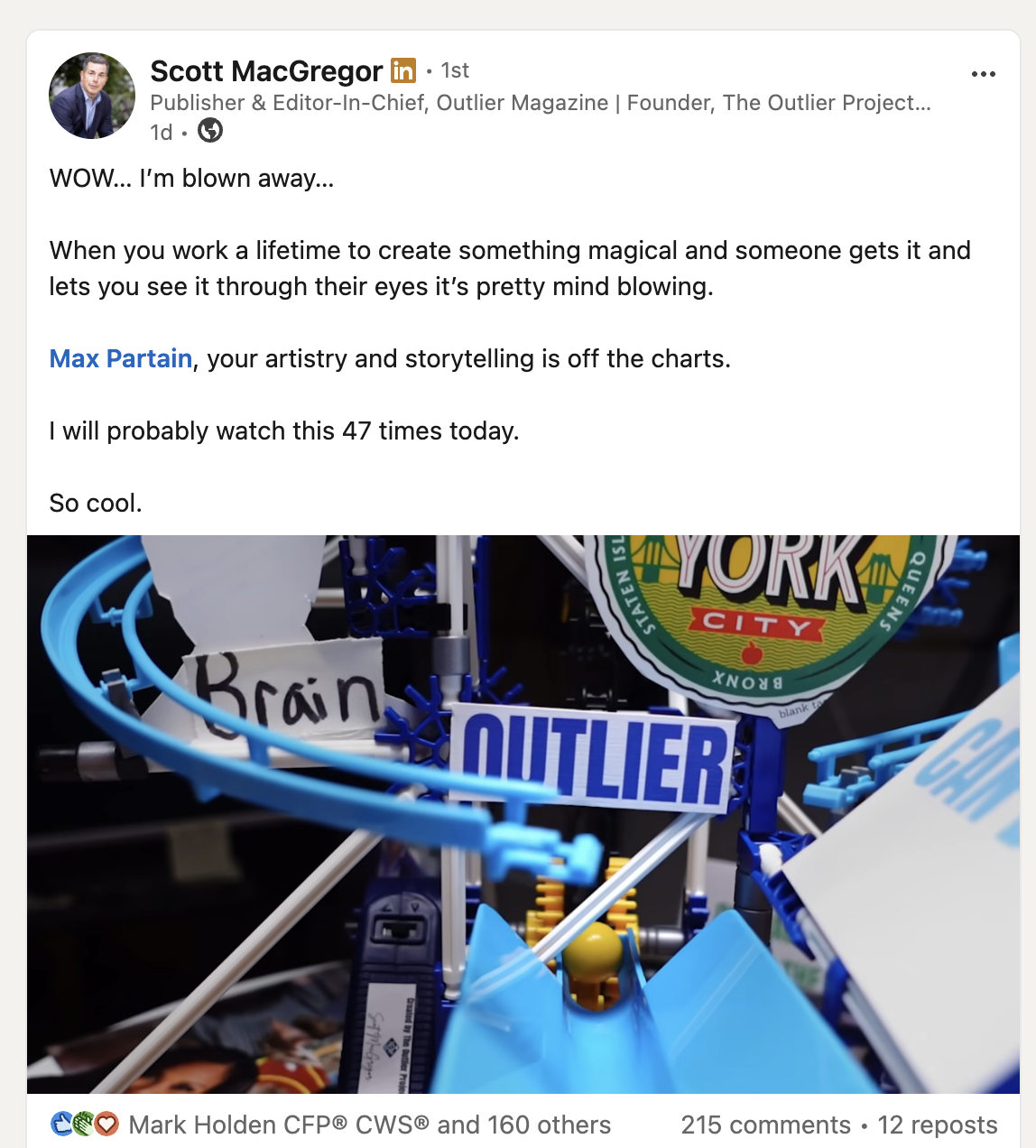
The central visual of the video is a desktop marble roller coaster. A single marble sits on the desk. That's you. The marble gets placed into the roller coaster. That's The Outlier Project. The machine carries it up, and at the top, four tracks branch out.
The metaphor does specific work. A roller coaster is not a classroom. You don't study a roller coaster. You get on it. The visual tells a prospective member that this is an experience, not a curriculum. The single marble becoming one of many at the end tells them they won't be on the ride alone.
The four tracks branching from one peak solve the Chinese menu problem visually before a word of explanation is spoken. Everything the Outlier Project does lives under one of four categories. The architecture is clear. The marble shows you where to go.
The Paper Videos
Each of the four sections is explained through a self-contained hand-drawn video. Max draws and talks. No motion graphics. No production package.
This was a deliberate choice. The Outlier Project's credibility comes from real people with real expertise showing up and giving real guidance. A polished brand video would have undermined that. The hand-drawn format signals the same thing the community itself signals: this is a person who knows something, talking directly to you.
Each paper video is also designed to stand alone. Scott can send the Business video to a prospective member who needs to know about the advisors. He can send the Buddies video to someone who came for the relationships. The explainer functions as a full piece and as four separate assets.
The Personal Proof
Max is a member of The Outlier Project. The video is built around his personal experience inside the community. The business section uses his actual results — a LinkedIn strategist named Kait Ledonne who changed how he showed up online, and a business coach named Christine who changed how he closed sales calls. Together they generated over thirty thousand dollars in new revenue.
The brain section includes the story of Max following Chris Do for five years on YouTube, learning from his content, never having access to him — and then getting to ask him a direct question during a Legend Series event inside The Outlier Project.
These aren't testimonials. They're specific, named, financially grounded outcomes. They tell a prospective member: here is what this actually looked like for a real person. Not what it could look like. What it did look like.
The Close
Scott McGregor's closing line was pulled from a recorded conversation between Max and Scott. Scott wasn't performing a pitch. He was answering a direct question about what the Outlier Project is. That unscripted answer became the final beat of the video.
The last line of the narration is: this is just my story within the Outlier Project. What do you think yours will be?
That's the ask. Not a button. Not a price point. A question.
Their Response
The Deployment
Scott spends the first ten minutes of every discovery call explaining what the Outlier Project is. This video replaces those ten minutes. It goes out before the call. Prospective members arrive already oriented. Current members have something they can forward to someone who asks them about the community.
The video also functions as an organizational document. As Scott rebuilds the website and restructures the community's programming around the four B framework, this video serves as the reference point for what that architecture means and why it exists.
The entire client-facing process required one working session. Max handled the diagnosis, the creative direction, the scripting, and the production. Scott and Kathy showed up once and got a finished asset